Fauvism
Fauvism is colorful style of painting developed by Henri Matisse and André Derain who used vibrant colors, simplified drawing and expressive brushwork.
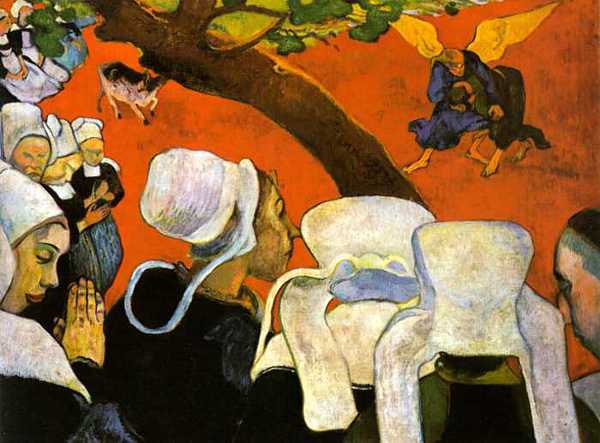
PAUL GAUGUIN (1884-1903)
'Vision after the Sermon', 1888 (oil on canvas)
Fauvism has its roots in the post-impressionist paintings of Paul Gauguin. It was his use of symbolic color that pushed art towards the style of Fauvism. Gauguin proposed that color had a symbolic vocabulary which could be used to visually translate a range of emotions. In 'Vision after the Sermon' where Gauguin depicts Jacob wrestling with an angel, he paints the background a flat red to emphasise the mood and subject of the sermon: Jacob's spiritual battle fought in a blood red field of combat. Gauguin believed that color had a mystical quality that could express our feelings about a subject rather than simply describe a scene. By breaking the established descriptive role that color had in painting, he inspired the younger artists of his day to experiment with new possibilities for color in art.
'Les Fauves'
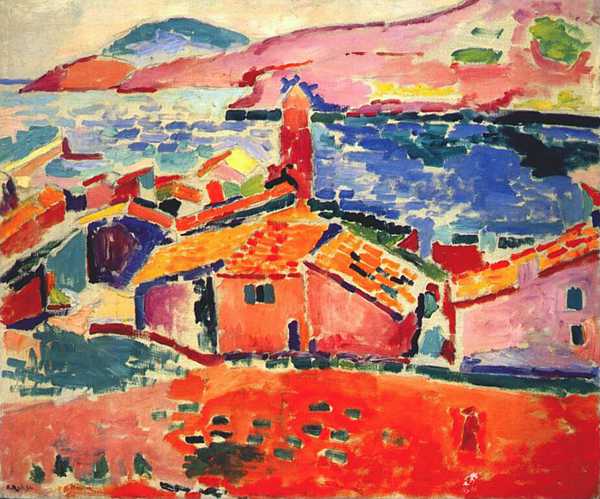
HENRI MATISSE (1869-1954)
'The Roofs of Collioure', 1905 (oil on canvas)
At the start of the 20th century, two young artists, Henri Matisse and André Derain formed the basis of a group of painters who enjoyed painting pictures with outrageously bold colors. The group were nicknamed 'Les Fauves' which meant 'wild beasts' in French. Their title was coined by the art critic Louis Vauxcelles who was amused by the exaggerated color in their art. At the Salon d'Automne of 1905 he entered a gallery where Les Fauves were exhibiting their paintings. Surprised by the contrast of their work with a typical renaissance sculpture that stood in the centre of this room, he exclaimed with irony, "Donatello au mileau des fauves!" (Donatello surrounded by the wild beasts!). The name stuck.
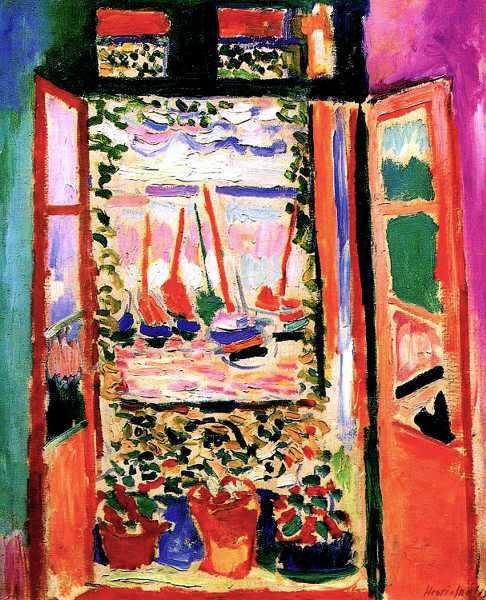
HENRI MATISSE (1869-1954)
'The Open Window, Collioure', 1905 (oil on canvas)
In 1905, Matisse and Derain went to stay in the port of Collioure in the south of France and the Fauvist pictures that they painted there revolutionized attitudes towards color in art. The sheer joy of expression that they achieved through their liberated approach to color was a shot in the arm for the art of painting. In Matisse's painting, 'The Open Window, Collioure', color is used at its maximum intensity. The window frames, clay flower pots and masts on the yachts have all been painted in a blazing red. These are a bold complement to the range of greens that punctuate the painting. In order to arrange the various colors of the work into an effective composition he creates a counterchange between the greenish wall on the left and its reflected color in the right hand window, with the purple wall on the right and its reflected color in the left hand window. To unify the interior/exterior relationship of space, the dense spectrum of colors used inside the room is echoed more sparingly in the distant view through the window.
At first glance, the apparent freedom of his style seems to deny any skill or technique, but when you begin to analyse his effective use of visual elements you start to realize that there is an instinctive sensibility at work. The key to his success in using such exaggerated colors was the realization that he had to simplify his drawing. He understood that if he intensified the quality of color for expressive effect, he must reduce the amount of detail used in drawing the shapes and forms of the image. By applying the same kind of simplification and spontaneity to his drawing and brushwork, Matisse was amplifying the sense of joy that he had achieved through color. He wrote, "We move towards serenity through the simplification of ideas and form.......Details lessen the purity of lines, they harm the emotional intensity, and we choose to reject them. It is a question of learning - and perhaps relearning the 'handwriting' of lines. The aim of painting is not to reflect history, because this can be found in books. We have a higher conception. Through it, the artist expresses his inner vision."
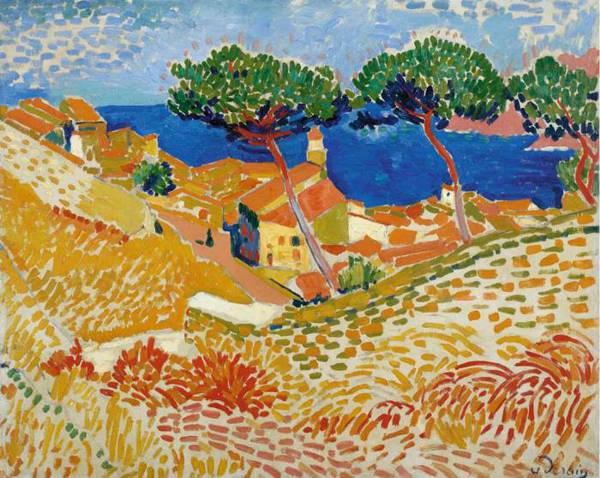
'View of Colloiure' (1905) by Andre Derain.
In 1906, after the success of his Colloiure paintings at the Salon d'Automne exhibition of the previous year, André Derain was commissioned by Ambroise Vollard, the French art dealer, to create a series of paintings about London. The subject had been previously tackled by Whistler and Monet who had focused on the foggy atmosphere of the industrial city. Derain's vision was a radical departure from this traditional view as he painted the capital in a palette more suited to a Mediterranean holiday resort. Altogether he produced thirty paintings in what has become a very popular series depicting many views along the Thames.
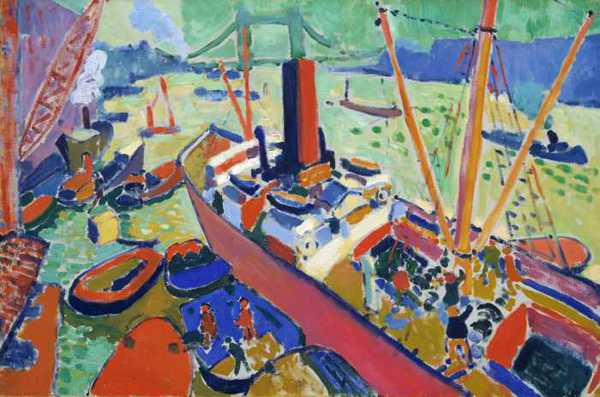
ANDRÉ DERAIN (1880-1954)
'The Pool of London', 1906 (oil on canvas)
Derain manages to balance the expressive and descriptive qualities of color in 'The Pool of London'. He uses the conflict between warm and cool colors to express the noise and activity of this busy dockyard. An illusion of depth in the painting is created by using stronger and warmer tones in the foreground, which gradually become weaker and cooler towards the background. This organized arrangement of tones in a landscape is called aerial perspective. The drawing of the image is typically simplified into shapes and forms whose details are conveyed by unmodified brushstrokes of roughly the same size. This gives the painting an overall unity that you would not expect in a composition of such conflicting colors.
Fauvism and Beyond
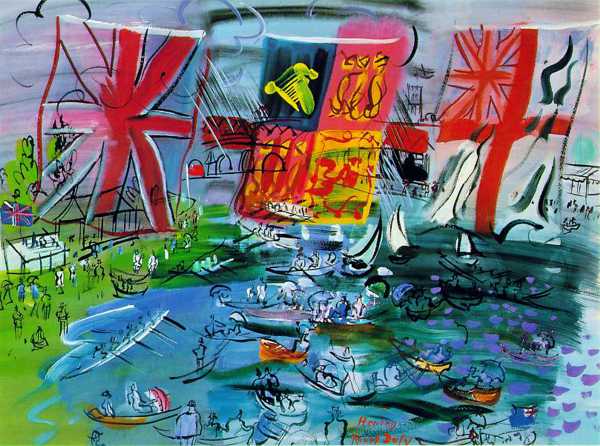
RAOUL DUFY (1877-1953)
'Henley Regatta', 1933 (gouache)
Henri Matisse and André Derain may be the two most important figures associated with the Fauve movement, but other great artists such as Maurice de Vlaminck, Albert Marquet, Georges Rouault, Raoul Dufy and the cubist Georges Braque all contributed their own variations to the style.
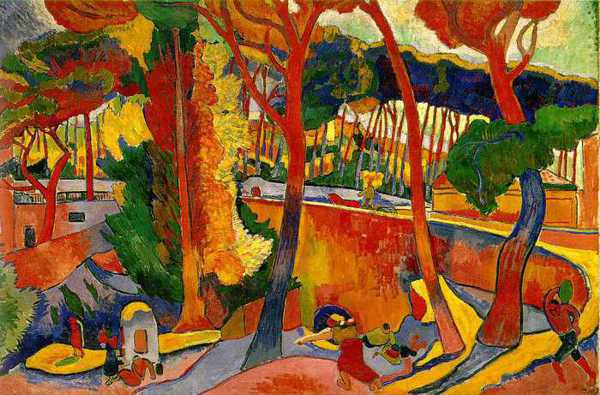
ANDRÉ DERAIN (1880-1954)
'The Turning Road at L'Estaque', 1906 (oil on canvas)
Fauvism was not a formal movement with a manifesto of rules and regulations. It was more an instinctive coming together of artists who wished to express themselves by using bold colors, simplified drawing and expressive brushwork. 'Les Fauves' simply believed that color had a spiritual quality which linked directly to your emotions and they loved to use it at the highest possible pitch.
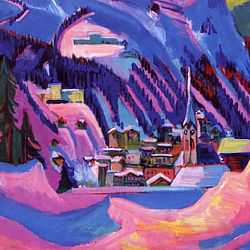
Within a few years, Fauvist techniques were adopted and developed by the German Expressionists and their various splinter groups. Fauvism was gradually subsumed into the canon of modern art, but its influence liberated the use of color for future generations of artists who ultimately explored color as an abstract subject in its own right.
Fauvism Notes
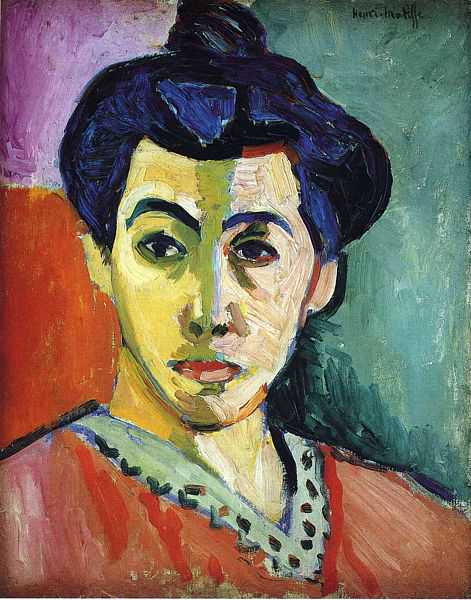
HENRI MATISSE (1869-1954)
'Green Stripe - Madame Matisse', 1905 (oil on canvas)
Fauvism was a style of painting developed in France at the beginning of the 20th century by Henri Matisse and André Derain.
-
The artists who painted in this style were known as 'Les Fauves'.
-
The title 'Les Fauves' (the wild beasts) came from a sarcastic remark by the art critic Louis Vauxcelles.
-
Les Fauves believed that color should be used to express the artist's feelings about a subject, rather than simply to describe what it looks like.
-
Fauvist paintings have two main characteristics: simplified drawing and exaggerated color.
-
Les Fauves were a great influence on German Expressionism.